
Why Tier 3 Science Fails (And It’s Not the Students)
Feb 09, 2026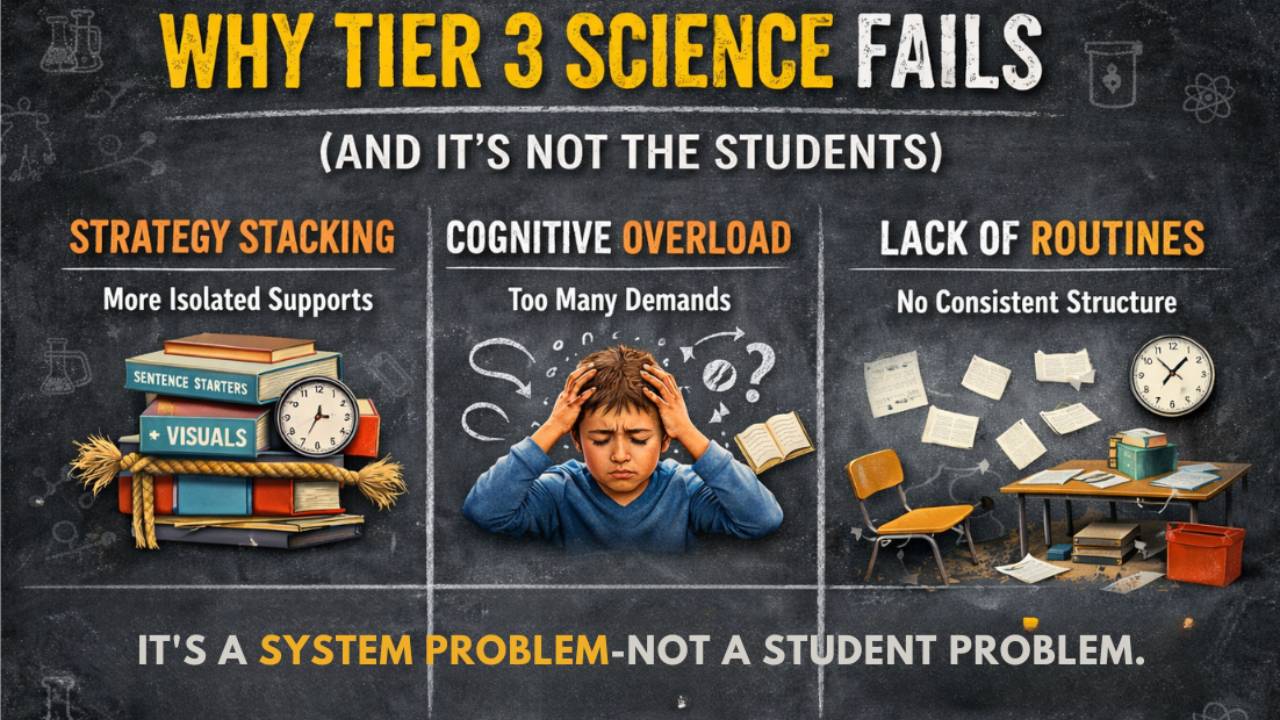
Why Tier 3 Science Fails (And It’s Not the Students)
If Tier 3 science feels harder than it should—if lessons fall flat, progress feels slow, and nothing seems to “stick”—this isn’t because you’re doing something wrong.
And it’s definitely not because your students “can’t do science.”
What’s actually failing is the system teachers are asked to use—one that was never designed for Tier 3 learners. Teachers are expected to solve a systems problem with isolated strategies. What looks like student struggle is often instructional overload inside an unsupported structure.
In this post, you’ll learn why Tier 3 science breaks down, what’s really happening cognitively for students, and what must change for learning to finally stick.
Tier 3 Science Can’t Be “More Scaffolds” of Tier 1
One of the most common assumptions in Tier 3 science is this:
If Tier 1 didn’t work, Tier 3 just needs more support.
More sentence stems.
More visuals.
More modeling.
More time.
This is what I call strategy stacking—layering more tools onto a lesson that was never designed for Tier 3 learners in the first place.
But Tier 3 science isn’t Tier 1 with extras. It’s a fundamentally different instructional job.
Tier 1 science is designed for students who can:
-
Hold multiple ideas in working memory
-
Transfer background knowledge automatically
-
Decode academic language while reasoning
Tier 3 students often cannot do all three at once.
When we simply layer scaffolds onto Tier 1 lessons, we unintentionally:
-
Increase cognitive load
-
Fragment attention
-
Confuse process with understanding
Strategy stacking doesn’t simplify learning. It burdens it.
What Tier 3 students need instead is a restructured learning experience, not an expanded one.
Academic Struggle vs. Cognitive Overload (They Are Not the Same)
Many Tier 3 students are labeled as “struggling,” but what they’re actually experiencing is cognitive overload.
Here’s the difference:
Academic Struggle
-
Students are confused about the concept
-
Errors are consistent and instructional
-
Progress improves with targeted practice
Cognitive Overload
-
Students can’t process directions and content
-
Errors are random, avoidant, or shutdown-based
-
Engagement drops even when tasks are “simpler”
Science is especially vulnerable to overload because it demands:
-
New vocabulary
-
Abstract reasoning
-
Multi-step processes
-
Cause-and-effect thinking
Imagine asking a Tier 3 student to:
-
Read a task card
-
Listen to verbal directions
-
Observe a reaction
-
Record data
-
Use academic vocabulary
-
Explain their thinking
That’s not rigor. That’s overload.
When routines are inconsistent, students spend their mental energy figuring out what to do, not what they’re learning.
Why Science Gaps Compound Faster Than Literacy or Math
Here’s a truth we don’t say out loud enough:
Science gaps don’t stay small—they stack.
In science, today’s misunderstanding becomes tomorrow’s barrier.
In literacy and math, students practice foundational skills daily. In science:
-
Concepts spiral quickly
-
Vocabulary builds concept on concept
-
Missed understanding resurfaces again and again
If a student doesn’t truly understand conservation of matter, that gap reappears in:
-
Chemical reactions
-
States of matter
-
Density
-
Systems and cycles
Without a clear intervention structure, Tier 3 students aren’t just behind—they’re constantly relearning without repairing.
The Real Problem: Lack of Routines, Not Rigor
When we’re unsure how to support Tier 3 learners, science often gets watered down in the name of “support.”
But rigor isn’t the enemy—uncertainty is.
When students don’t know:
-
How lessons will start
-
What thinking is expected
-
How to show understanding
-
What success looks like
Their brains stay in survival mode.
High-performing Tier 3 classrooms don’t reduce rigor.
They reduce decision fatigue through:
-
Predictable lesson structures
-
Consistent task formats
-
Repeated thinking routines
Routines create safety.
Safety creates engagement.
Engagement makes learning possible.
Immediate Classroom Use
Tier 3 Science Reality Check
Self-score honestly. This is about systems—not judgment.
Rate each statement:
-
0 = Rarely
-
1 = Sometimes
-
2 = Consistently
| Statement | Score |
|---|---|
| My Tier 3 science lessons follow the same predictable structure | |
| Students know exactly how to start without repeated directions | |
| Vocabulary is anchored visually and reused daily | |
| Hands-on tasks are structured, not open-ended | |
| I collect quick evidence of thinking every lesson |
0–4: System missing
5–7: Partial structure
8–10: Strong Tier 3 foundation
If your score is low, that’s not failure—it’s information.
Reflection question:
Which part of my Tier 3 science system is missing—not because I didn’t care, but because no one ever taught me how to build it?
Stop Doing / Start Doing: Tier 3 Science Instruction
| Stop Doing | Start Doing |
|---|---|
| Re-teaching Tier 1 lessons with more time | Rebuilding lessons with fewer cognitive demands |
| Adding more steps “to help” | Streamlining tasks to focus on one thinking goal |
| Assuming engagement = understanding | Checking thinking through structured responses |
| Changing formats constantly | Repeating routines until they become automatic |
How a Tier 1 Lesson Breaks Down at Tier 3
Tier 1 Task:
Students rotate through stations to explore physical vs. chemical changes, record observations, and explain their reasoning.
What Happens at Tier 3:
-
Students struggle to read station cards
-
Directions are forgotten mid-task
-
Observations stay surface-level
-
Explanations rely on guessing or copying
Why It Breaks:
Too many demands at once:
-
Reading
-
Observing
-
Recording
-
Reasoning
-
Explaining
Tier 3 Fix (System Shift):
-
One routine used every day
-
One concept per session
-
Visual anchor stays visible
-
Sentence frames reused across lessons
-
Thinking checked verbally and visually
Same concept.
Different system.
The Truth Teachers Need to Hear
If Tier 3 science hasn’t worked the way you hoped, it’s not because:
-
You lack skill
-
You didn’t try hard enough
-
Your students aren’t capable
It’s because you were asked to build an intervention system without being given one.
That’s not a personal failure.
It’s a design problem.
Teacher Walkaway Thought
“I’m not behind. I’ve been unsupported.”
In the next post, we’ll explore what Tier 3 science students actually need—and why meeting those needs changes everything.