
What Tier 3 Science Students Actually Need (That Most Classrooms Don’t Provide)
Feb 16, 2026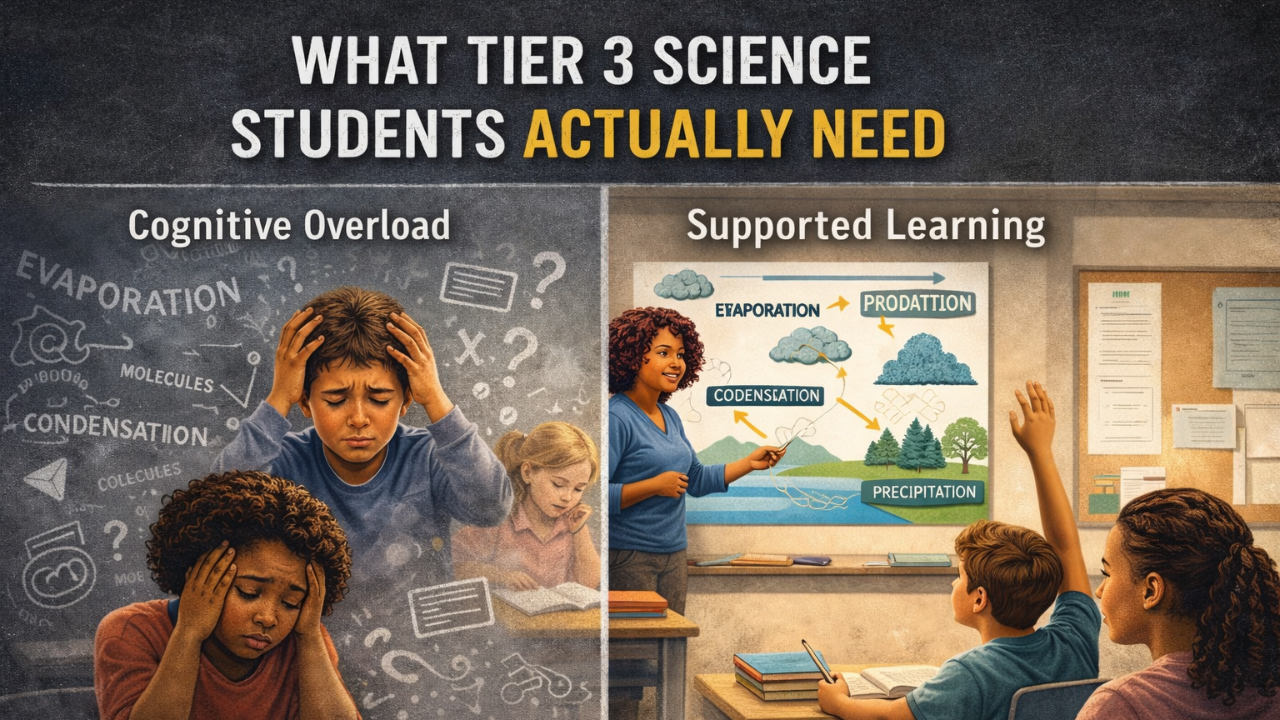
What Tier 3 Science Students Actually Need
(That Most Classrooms Don’t Provide)
By the time many students reach Tier 3 in science, they’ve already decided something about themselves:
“Science isn’t for me.”
“I’m bad at this.”
“I never get it anyway.”
These beliefs don’t come from a lack of effort or curiosity. They come from how science has been experienced cognitively and emotionally over time.
To truly support Tier 3 science students, we have to move beyond vague solutions like “make it hands-on” or “add more practice.” What these students need is instruction designed for how their brains process information, not how we wish they would.
This post breaks down what Tier 3 science students actually need—cognitively and emotionally—and how to plan instruction that finally works for them.
Why Tier 3 Students Struggle With Language and Abstract Reasoning in Science
Science is a language-heavy discipline wrapped inside abstract thinking.
Tier 3 students are often expected to:
-
Learn new vocabulary
-
Apply it immediately
-
Reason about things they can’t see
-
Explain cause-and-effect relationships
All at the same time.
For many Tier 3 learners, language processing and abstract reasoning compete for the same mental space. When that space is overloaded, understanding collapses.
This is why you might see a student:
-
Understand a demonstration but fail to explain it
-
Memorize definitions without grasping meaning
-
Perform well in discussion but poorly on written tasks
When Tier 3 students are asked to learn new words, reason abstractly, and explain their thinking simultaneously, something has to give—and it’s usually understanding.
It’s not that the concept is too hard.
It’s that the pathway to the concept isn’t supported.
Visual Anchoring and Concept Permanence: The Missing Piece
One of the most overlooked needs of Tier 3 science students is concept permanence.
Tier 1 students can often hold ideas in working memory long enough to connect them later. Many Tier 3 learners cannot.
That’s where visual anchoring matters.
Effective visual anchors:
-
Stay visible throughout the lesson
-
Represent the idea, not just the activity
-
Are reused across days, not replaced
When concepts disappear as soon as the activity ends, Tier 3 students are forced to start from zero every time. Over time, this creates frustration—not learning.
Visual anchoring is not about making science pretty.
It’s about making thinking visible and permanent so learning has something stable to attach to.
Why Repeated Exposure Does Not Equal Understanding
A common Tier 3 misconception is:
“They just need to see it more times.”
But repetition without structure leads to familiar confusion, not mastery.
Repeated exposure fails when:
-
The task changes every time
-
The thinking demand isn’t explicit
-
Students don’t know what they’re supposed to notice
Tier 3 students don’t benefit from more experiences.
They benefit when the same thinking is revisited through the same structure, so mental energy can go toward understanding—not navigation.
Without that, repetition becomes exhausting—and ineffective.
Science Fatigue: What Tier 3 Students Are Really Experiencing
Tier 3 science fatigue isn’t about laziness or low motivation.
It’s what happens when students:
-
Work hard but still feel confused
-
Try repeatedly without seeing progress
-
Associate science with failure or embarrassment
Over time, students protect themselves by disengaging.
This can look like:
-
Avoidance
-
Silence
-
Off-task behavior
-
Over-reliance on peers or copying
Science fatigue is data.
It tells us the system needs redesign—not that students need more effort.
When teachers recognize fatigue for what it is—a protective response—instructional decisions change.
Immediate Classroom Use
Tier 3 Science Student Profile
(Cognitive + Emotional)
Cognitive Characteristics
-
Limited working memory for multi-step tasks
-
Difficulty processing language and reasoning simultaneously
-
Needs concrete representations to support abstract ideas
Emotional Characteristics
-
Low confidence in science
-
Fear of being wrong publicly
-
Quick disengagement after repeated confusion
This profile isn’t a deficit list.
It’s a design guide.
Non-Negotiables for Tier 3 Science Lessons
Before planning a new Tier 3 science lesson, use this checklist to pressure-test the design—not the students:
-
☐ One clear concept focus per lesson
-
☐ Visual anchor visible the entire time
-
☐ Predictable routine students recognize immediately
-
☐ Language supports tied directly to the concept
-
☐ Structured way for students to show thinking
If a lesson is missing more than one of these, Tier 3 students will struggle—regardless of effort.
Before / After: What Changes at Tier 3
Before (Tier 1 Default)
-
New activity each day
-
Directions explained verbally
-
Vocabulary introduced once
-
Understanding checked at the end
After (Tier 3 Designed)
-
Same routine daily
-
Directions embedded into the structure
-
Vocabulary anchored visually and reused
-
Thinking checked continuously
Same standards.
Different design.
What This Means for Teachers
Tier 3 students don’t need:
-
Easier science
-
Less rigor
-
Endless repetition
They need:
-
Stability
-
Visibility
-
Purposeful structure
When instruction matches how their brains learn, confidence grows—and understanding follows.
Teacher Walkaway Thought
“This explains my students—and now I know how to plan for them.”
In the next post, we’ll look at how to turn these needs into a clear Tier 3 science lesson structure that removes guesswork for teachers and reduces overload for students.